
 Kontakt zu einem Ingenieur
Engineering Actuators for Extreme Environments
A holistic approach to protective design can greatly reduce or eliminate the harmful effects of harsh environmental conditions on electric actuators.
With their performance and efficiency advantages over hydraulics, electric actuators are increasingly used in unforgiving operating environments that demand hardened components. Yet, not every actuator is up the task of thriving or even surviving under the harshest conditions.
Most off-the-shelf actuators are simply not engineered to withstand the corrosive agents, temperature extremes, ingress of foreign material, high shock loads and electromagnetic interference (EMI) that characterize many harsh environments. If you’re designing a system that will need to perform in these conditions, here’s an overview of what to look for in an actuator.
Corrosion and Particulate Ingress
Corrosive environments can reduce performance and life by eating away at housing, seal and fastener materials. Particulate ingress can cause moving components to wear faster while moisture can short electrical connections. Ensuring a component is well-protected against corrosive agents, moisture and particulates is critical to ensure a ruggedized actuator design.
To combat corrosion, select actuators with corrosion-resistant materials such as stainless steel. These actuators are commonly used in hygienic applications like food and beverage manufacturing where caustic cleaning agents are frequently used. But stainless steel construction isn’t exclusive to the food and beverage industry — mining, packaging and agriculture feature corrosive environments as well.
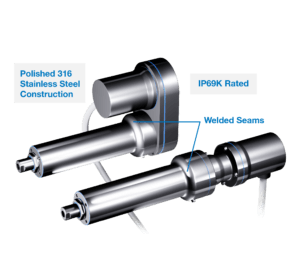
Actuators designed for extreme environments will feature fewer ingress points and corrosion-resistant materials like 316 stainless steel. |
Salt spray is also an ever-present corrosive threat to components in marine applications. Actuators featuring stainless steel construction are effectively protected from salt and other corroding agents in marine environments.
Protecting the actuator with a paint finish is an additional strategy for increasing an actuator’s durability in harsh environments. This can be especially useful in outdoor applications where actuators are subjected to wide temperature changes, debris and weather. Special paints, like chemical agent resistant coating (CARC) used for tactical military equipment, can further boost longevity — enabling an actuator to last 15 to 20 years outside.
Ingress protection is another important consideration when addressing harsh environments, and a well-sealed actuator housing is the solution. Welding the seams of an actuator’s housing removes pathways for particulates to reach the internal components. But not all ingress points can be entirely eliminated. Effective seals remain crucial to ensuring adequate protection. Consider an actuator’s seal materials and look for seals with high corrosion resistance. Custom-extruded seals further improve protection by ensuring a tight seal.
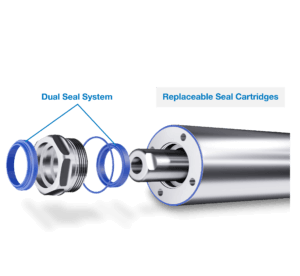
Easily swappable seal cartridges facilitate quick replacements to ensure the actuator maintains excellent protection throughout its life. |
Extreme Temperatures
Although electric actuators don’t require hydraulic fluid to run, extreme heat or cold can still affect operation. Cold temperatures can increase lubricating grease viscosity and reduce lubrication effectiveness, and extreme heat can degrade greases and render them ineffective.
Extremely hot environments can cause materials to thermally expand, creating new ingress points in the actuator. This occurs when adjacent materials have significantly differing coefficients of thermal expansion. As the materials heat up, gaps form. Quality actuator suppliers are aware of this potentiality, and they carefully consider thermal expansion when selecting construction materials for actuators in extreme temperatures.
Tolomatic’s Commitment to DurabilityTolomatic offers a wide range of durable electric actuators that stand up to the toughest environments. For example, the RSH hygienic actuator features 316 stainless steel construction, custom-extruded seals and an IP69K ingress rating as standard. Initially intended for corrosive food and beverage environments, its robust protection is useful in many rugged applications. Additional options are available to boost an actuator’s durability beyond its standard capabilities, such as the HT option for RSA roller screw actuators, which improves its thrust capacity, component strength and shock and vibration resilience. |
Shock Loads and Vibration
Select roller screw actuators over ball screw designs if shock and vibration are a concern. Roller screws are inherently more resilient to shock loads because of their greater contact area between screw threads and the bearings. With ball screws, high shock loads and vibrations can deform the bearings and reduce their performance. By design, roller screws have more contact area to disperse loads within the screw and are stiff enough to avoid deformations.
Shock and vibration protection can be increased by improving an actuator’s stiffness. Tolomatic accomplishes this by enhancing the actuator’s thrust bearing journal with increased hardness. The bearing’s design is altered to improve the rigidity at the screw-bearing interface, which increases the actuator’s overall stiffness.
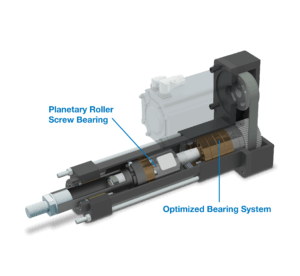
High-force actuators are equipped to handle high shock and vibration environments due to excellent load dispersion, stiffness and rigidity. |
Electromagnetic Interference
Most concern over electromagnetic interference (EMI) with electric actuators is to ensure the motor and sensors are protected. For example, integrated servo actuators are commonly used in resistance spot welding and feature integrated force sensors for feedback and control. These actuators must have adequate shielding from EMI to maintain correct performance during welding.
If using a third-party motor with your actuator, make sure that the motor is shielded from EMI. Integrated actuators are usually safe from EMI due to their lack of sensitive electronics, but
an EMI-shielded motor is still beneficial. Work with an actuator supplier that keeps EMI protection in mind, and they will help you
select shielded motors.
Roadmap to Resilience
When considering an electric actuator for harsh environments, it’s important to look beyond sealing against dust and debris. Take a holistic look at all harmful aspects that can impact actuator performance and life. Working with the experts at your supplier is a surefire strategy to maximize the performance and life of your actuator in tough environments.
Contact us to learn more.